Accurate, realistic, and beautiful façade images are enormously helpful in turning your proposal into a signed contract. Below you can see many examples of my work, renderings that have been commissioned for use in official proposals by an ever-growing number of organ-builders across America.
Many of these jobs involve working directly with builders to convert their own 2D plans into photo-realistic renderings that allow end-clients to see exactly what a façade would look like in the context of their existing architecture. Over time — and due to my first-hand professional experience with installations, tuning, and maintenance — I started helping some builders to modify and refine their plans. I also began to receive commissions from builders to create original designs, and found myself working alongside architects to incorporate renovations beyond just the organ into the final images I provide. (While I am not an architect or structural engineer myself, I can provide considerable insight to people in those professions to be sure that an organ is properly incorporated into larger site-overhaul projects.)
In addition, I have experience working interactively and iteratively with end-clients (organ committees, etc.) via online video-conferencing. Through screen-sharing, I can present and “fly around” my working copy of a 3D model in real time so that others can gain a much deeper understanding of a design than 2D images may offer. I can also prepare all sorts of variations and quickly switch between them (alone or in combinations) while discussing the thought processes behind their origins and explaining their pros and cons; this allows your clients to understand, and engage meaningfully in, the design process, contributing their own informed choices and greatly increasing their excitement about, and sense of ownership of, the proposed instrument.
Click on any image to see a larger version.
Plymouth Congregational Church, Lawrence, KS, for Schoenstein & Co.
(my original design)
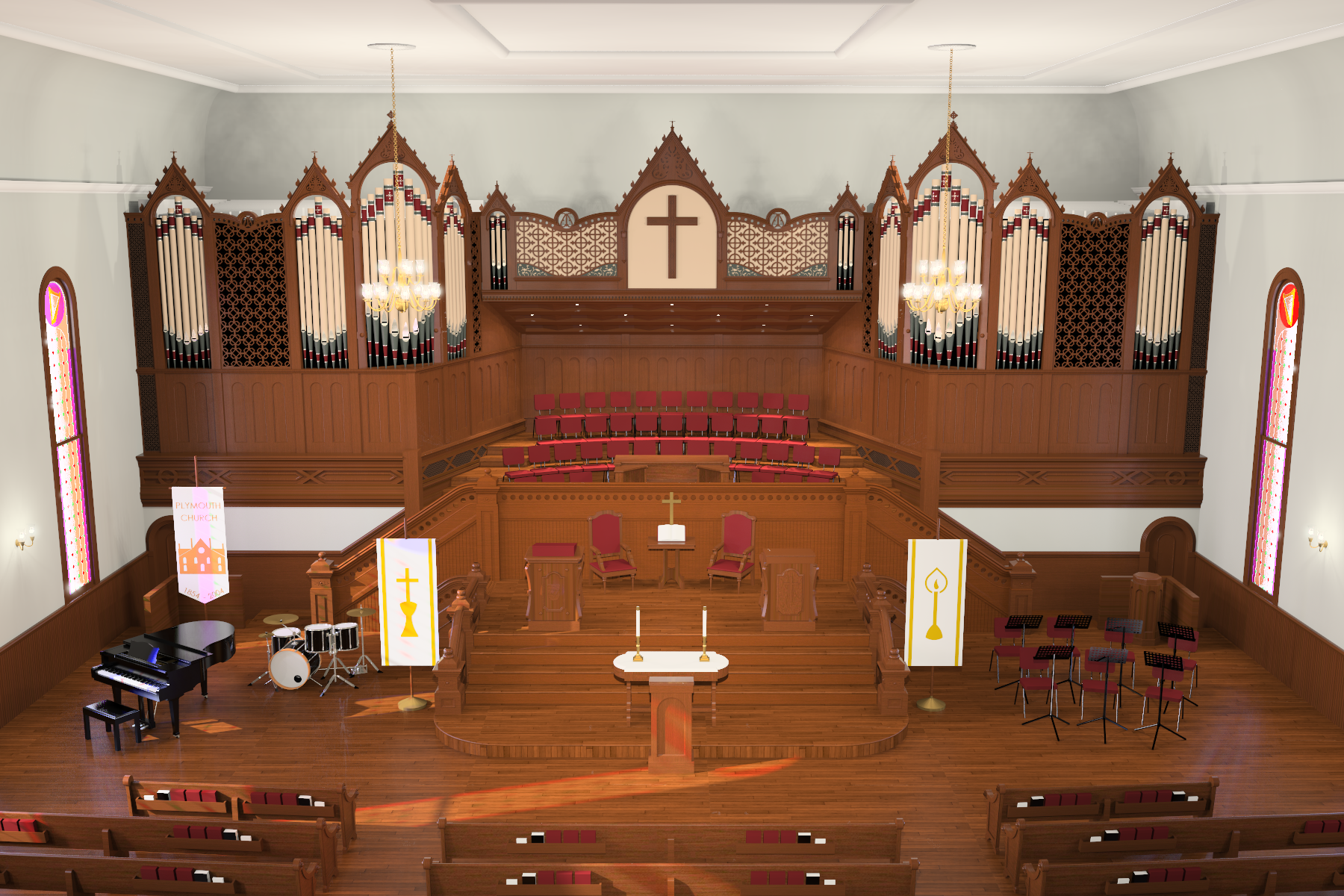
At the invitation of Schoenstein Organ Co., I designed and rendered this original organ façade for Plymouth Congregational Church, surrounding a new choir loft by the architectural firm of clark | huesemann (who kindly provided their CAD model of the room, enabling me to extensively explore color and lighting and add various small details for additional realism, and ultimately to create the entire image above without needing an actual photo as a background image). This is my first original design to receive official client approval and be scheduled for construction (the organ will be completed in 2028).
The project brief was to design an original wall-to-wall façade large enough to enclose the new organ: something more visually-coherent and true to the church’s 19th-century origins than the eclectic 1970 Reuter façade it is replacing, and incorporating as many speaking basses as possible (but not being a continuous pipe-fence). To maintain a sense of familiarity, satisfy funding requirements linked to historic preservation, and reduce construction costs, substantial amounts of woodwork from the church’s previous organs (arches, panels, and curved tracery) were to be reused. Also, the case footprint had already been set by the architects’ choir-loft design and the organ-builder’s need for as much chamber space as possible; and an acoustician’s specifications for the choir-loft ceiling needed to be met, in conjunction with ADA requirements relating to a hidden choir-loft door to an elevator installed behind the Great division.
My immediate impression was that the new design needed to de-emphasize the loft’s width and create a sense of focus on the center of the chancel area. Accordingly, I adapted the 19th-century motif of a large arch flanked by two smaller arches into a pair of two such groupings that flow around the newly-obtuse corners of the redesigned choir loft, each facing toward the altar. These overlap with a narrowed version of the grouping seen in all the previous organs of two arches joined by upper curving tracery, with these groupings now moved closer to the outer walls; the outermost arches are echoed by small arches in the façade’s central section, which in turn form a triptych with the 1970 arch in the middle (for which I also designed a new cross with carvings based on an existing pattern on the walls beneath the loft).
The outer screens use a design adapted from the stained-glass windows, while the screens flanking the cross are based on the two tiny wood crosses over the tallest pipe-flats (and the green panels beneath these screens contain floral carvings that I designed to complement the carvings in the original arches, which originals are not precisely replicated in this rendering). Keyhole moulding beneath the central section mirrors that on the lower edge of the rear balcony; and the small silver crosses on the red bands at the tops of the highest pipes are copied from a trio of white crosses on red panels in a stained-glass window over a doorway.
Careful use of color and light were essential in making this large design blend in with the room. Where the ceiling center was previously beige, Jane Huesemann recommended that it be all-white, providing instant relief from the new façade’s weight. I reused a similar cream color on the pipework and central fabric-backed screens to harmonize them with the woodwork (amazingly, the decorated pipes end up calling far less attention to themselves than all-silver pipes, as determined by a series of test renderings). The wine-red of the upholstery, hymnals, and carpeting (the last of which is being removed during the renovations) became an accent color that I used while adding banding on the pipes to play off the motion of the pipe-mouth pattern; and the sage green is a supporting color drawn from the hue of the walls and creating a rolling-hill pattern across the pipe-feet and under the screens flanking the cross. The three largest arches conceal precisely-shaded light sources that gently wash away shadows created by the façade’s bulk.
This process was extensively collaborative — not just with the organ-builder and architects (with whom I worked on issues including layout optimization, tuning-safe HVAC integration, and ADA compliance), but with the church’s Project Management Committee. Through a series of Zoom meetings, I shared several variants of many elements of the design with the committee, explaining the reasoning behind each one and allowing the committee to provide feedback and ultimately choose a combination of elements that came together as a cohesive whole that felt right to everyone. So, while this design is one for which I provided a new overall vision and various details to give it coherence and to integrate it with the rest of the sanctuary’s architecture, it is ultimately successful and meaningful because it also contains many cherished elements designed by previous builders and because its overall feel was decided on by members of the church. You can view my final detailed presentation to the wider congregation here.
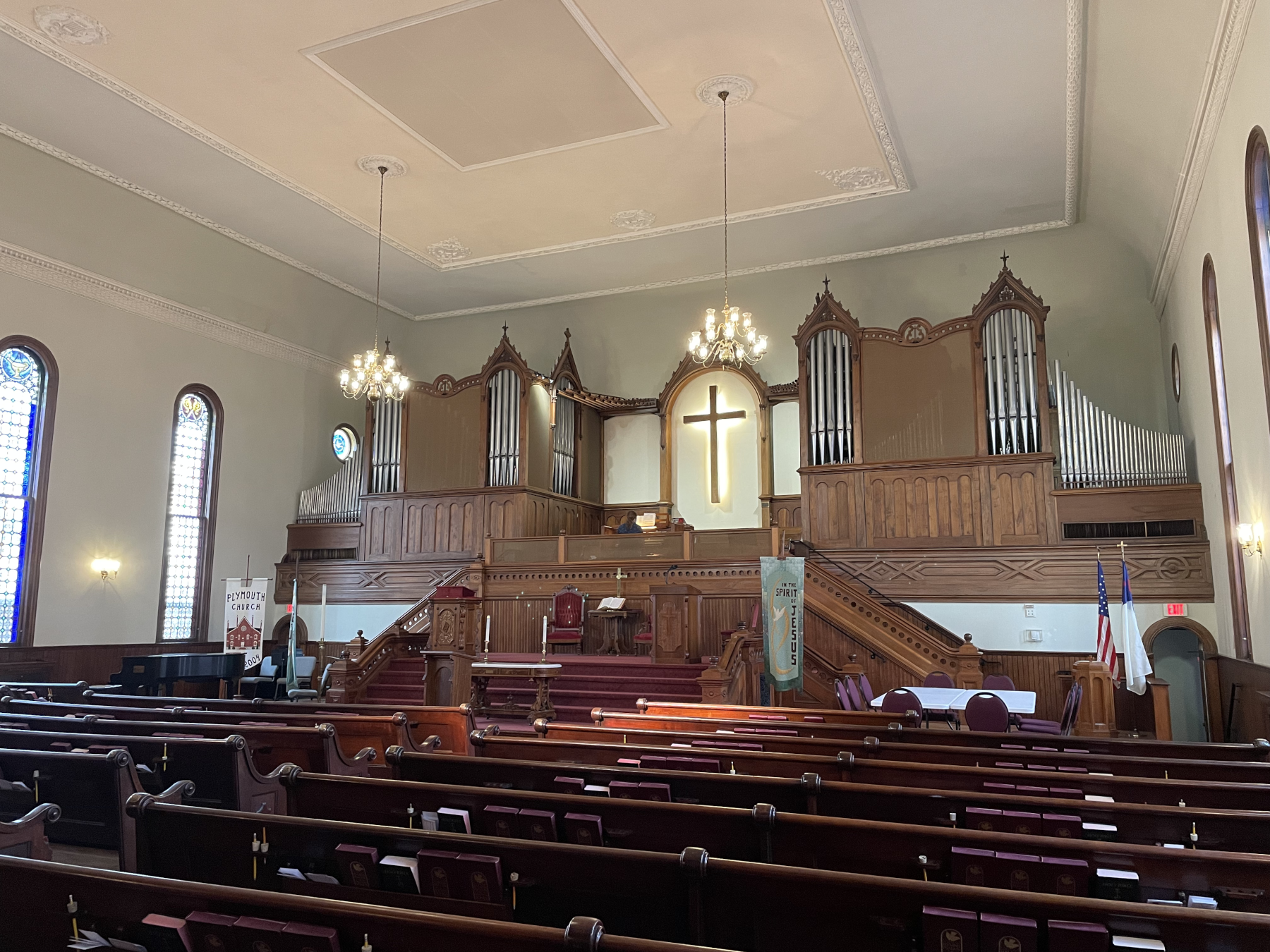
View precursor photo here.
Saint Philip’s Episcopal Church, Coral Gables, FL, for Schoenstein & Co.

Façade, pulpit, and chancel layout by Terry Byrd Eason Design. This job involved rendering not only the façade, but also the new pulpit, a relocated baptismal font and chairs, and a moved and widened communion rail. Schoenstein had only become aware of my services shortly before a rendering was needed for an important presentation, and reached out to me with the challenge of completing the entire task within five days; I delivered the image on-time, the church approved the project, and Schoenstein is now building the organ (scroll down to the green section titled “Upcoming Projects”).
View precursor photo here.

Proposal for Spencer Organ Company.
(my original design)

Norman and liturgical detailing. Composed of speaking bass pipes to save chamber space.
View precursor photo here.

Calvary United Methodist, Frederick, MD, for Cornel Zimmer Organ Builders.

I assisted Zimmer with some design changes while turning their 2D plans into a 3D model.
View precursor photo here and installation photo here.


View precursor photo here.

St. Edith Catholic Church, Livonia, MI, for Wigton Pipe Organs.

Made to the builder’s specifications; the added pipes are alternating flues and reeds.
View precursor photo here and post-installation photo here.


Proposal for Angerstein Organ Works.
(my original design)

The design replaces a bland pipe-flat with a dynamic arrangement of speaking basses.
View precursor photo here.

Façade rendering for Cornel Zimmer Organ Builders.

This image captures the interplay of natural and incandescent lighting across the pipework.
View precursor photo here.

Proposal for Spencer Organ Company.
(my original design)

The design of the the façade visually unifies the high altar, hanging cross, and rose window. This is likely going to be built — more info coming soon.
View precursor photo here.

WELCOME-----FAÇADES-----CONSOLES-----PROCESS-----ABOUT ME-----CONTACT